
Entity kinds
BODY, INSTRUMENT, EAR, FIELD.
Csound Teatro gives humans and machines one inspectable language for saying what exists, how things relate, when relations apply, how values map, what Ear observes, and what a Scenario is allowed to execute.
The canonical Scenario is semantic authority. Physics supplies events, Csound realizes sound, WebGL projects state, Ear measures, MIDI2 carries governed lifecycle, and FountainStore keeps evidence. None of those adapters may silently invent semantic meaning.
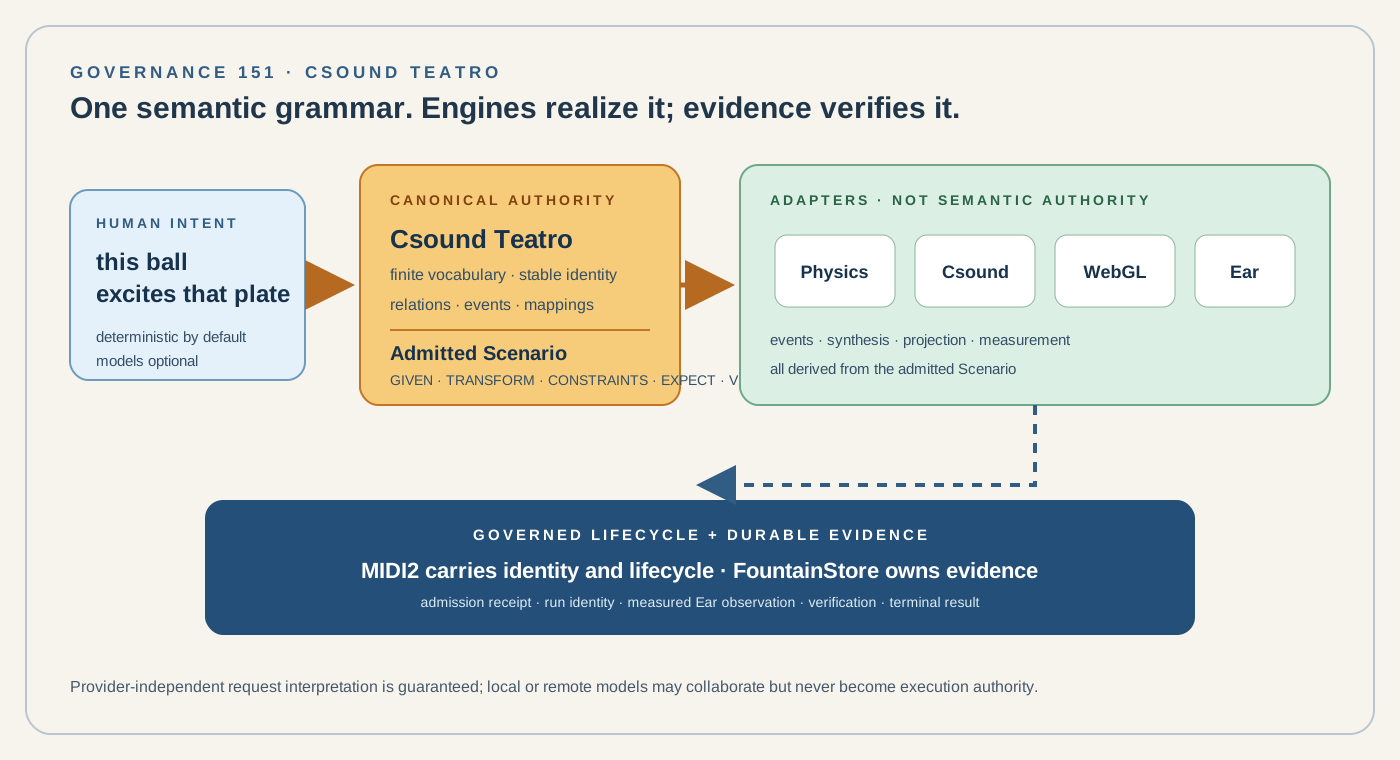
Grammar v0.1 admits the predicates below. Unknown predicates are rejected before execution.
PRODUCES · RECEIVES · EXCITES · CONTROLS · MODULATES · MAPS_TO · TRIGGERS · FOLLOWS · CONTAINS · OBSERVES · LISTENS_TO · AFFECTS · ABOVE · BELOW · NEAR · INSIDE · OUTSIDE · TOUCHING · MOVING_TOWARD · MOVING_AWAY
BODY, INSTRUMENT, EAR, FIELD.
GIVEN, TRANSFORM, CONSTRAINTS, EXPECT, VERIFY, plus grammar and schema version.
Source property, target port, domains, units, transfer, clamp, interpolation and update mode are explicit.
WHEN collision(Ball.01, Plate.01)
    Ball.01 EXCITES Plate.01

Ball.01.velocity 0..7 m/s
    MAPS_TO
Plate.01.excitation 0..1 normalized

Ear.01 LISTENS_TO Plate.01

AFTER collision(Ball.01, Plate.01)
EXPECT Ear.01.onset == true WITHIN 50 ms
The 50 ms value belongs to this admitted fixture. A different Scenario must declare and justify its own assertion boundary.
The built-in path works without network inference, API keys or provider credits. Supported human requests resolve through authoritative selection and discovered capabilities. Unsupported language is refused rather than guessed. Apple on-device models, Linux-local models, Codex or other providers can collaborate behind the same narrow intent contract.
The accepted Ball/Plate/Ear fixture establishes provider-independent interpretation, native pre-effect admission, physics collision, declared mapping, Csound-backed excitation, measured Ear onset, native verification, Store evidence and terminal MIDI2 lifecycle for that fixture. It does not establish universal grammar coverage, human hearing, arbitrary natural-language understanding or public release.